

Get Window Stickers for Classic Cars Made Before 1981
Want to know exactly how your vintage ride looked when it rolled off the factory line? Our classic window sticker service brings back those original details for any car made before 1981, giving you authentic factory build specs.
What is a Classic Window Sticker?
A classic window sticker is a document that shows the original factory information for older cars. It’s like the car’s birth certificate, listing every piece of equipment the car came with when it was brand new.
These stickers, often called classic car build sheets, help you understand what made a car special back in the day. You can see the original base price (MSRP), paint color, and all the features it had from the factory.
What Information Will I Find on a Classic Window Sticker?
A classic car window sticker contains detailed factory information about any vintage car. Here’s what you’ll typically find in our window sticker for classics:
Vehicle Specifications
Basic details that identify your car and describe what it was built to do.
Year, Make, and Model
Shows exactly what car you own, including the production year and official name from the factory.
Body Style and Trim Level
Tells you if it’s a coupe, sedan, or convertible, plus the specific trim package it came with.
Standard/Optional Equipment
Lists everything your car included, both regular features and special add-ons the first owner chose.
Factory-Installed Features
Shows items like air conditioning, radio, power windows, or special interior packages that came from the factory.
Additional Order Options
Identifies buyer-selected upgrades like upgraded interiors, or performance packages at an extra cost.
Engine Specifications
Details about the motor under your hood and how powerful it was when new.
Displacement and Horsepower
Tells the engine size in cubic inches or liters and how much power it made.
Carburetor or Fuel Injection Type
Shows what system fed fuel to the engine and any special performance features it had.
Capacities
Information about how much your car can hold, from fluids to passengers and cargo space.
Fuel Tank Size
States how many gallons of gas the tank holds when completely full for long trips.
Required Fluid Volume
Shows oil capacity, coolant volume, transmission, differential and brake fluid specifications for maintenance purposes.
Original Base Price
This is the manufacturer’s suggested retail price (MSRP) for the base model, without the options, taxes, and destination charges.
Manufacturer's Suggested Retail Price
Lists what the factory said the car should cost before any dealer markups or discounts.
Optional Equipment Costs
Shows extra money paid for add-ons like fancy wheels, a better stereo, or upgraded upholstery choices.
System Specifications
Technical details about important systems that make your car run, stop, and handle the road.
Transmission Type
Identifies if it’s automatic or manual and how many gears it has for shifting.
Brake and Suspension Setup
Describes whether it has drum or disc brakes and what suspension parts came standard.
Exterior Colors (Paint Type)
The exact factory color name and paint type that covered your car when new.
Original Color Code
Shows the manufacturer’s official name and number for the paint color they sprayed on.
Paint Finish Type
Tells if it was metallic, solid, two-tone, or special custom paint from the factory.
Wheels, Rims, and Tires
Details about what your car rolled on straight from the assembly line back then.
Wheel Size and Style
Lists the diameter and width, plus whether they were steel, chrome, or special alloy wheels.
Original Tire Specifications
Shows the tire size, brand, and type that came mounted from the factory for safe driving.
Dimensions
Measurements that tell you exactly how big your car is from every angle and direction.
Length, Width, and Height
Gives exact measurements in inches or feet so you know how much space it takes.
Wheelbase and Ground Clearance
Shows the distance between front and rear wheels, including how high it sits off the ground.
How Can You Benefit From Getting a Classic Window Sticker?
A classic window sticker helps both buyers and sellers make smarter decisions about vintage cars today. Here’s how this documentation helps:
Buyers
The window sticker gives you confidence when shopping for a classic car that matches your dreams perfectly.
Verify Authenticity
Check if the car still has its original engine, paint, and features, or if things have changed.
Know Fair Market Value
Compare what the car originally cost with today’s prices to understand if you’re paying right.
Understand Rarity
Learn which options were rare back then, making your potential purchase more valuable and special.
Sellers/Dealers
The Monroney label for classic cars helps you prove your classic car’s worth and attract serious buyers who pay top dollar. Sellers benefit in the following ways:
Prove Original Condition
Show buyers hard evidence that your car keeps its factory parts and hasn’t been heavily modified.
Justify Asking Price
Use original pricing and rare options to explain why your car deserves the money requested.
Build Buyer Confidence
Give potential customers documentation that makes them trust your car is the real deal.
Restorers
A build sheet is a classic car restorer’s best friend. Here is why.
Find the Right Original Parts
It shows exact factory parts, helping restorers source and fit correct components easily.
Prove the Car is Authentic
A build sheet confirms original features, making the classic car worth significantly more money.
Save Time During Restoration
Restorers know the exact colors, options, and equipment fitted, removing all the guesswork instantly.
How to Look Up a Classic Car Window Sticker
By using your vehicle identification number, follow these easy steps to get your classic window sticker:
Enter the Classic VIN
Type or paste your car's VIN carefully into the form at the top of the page. You can also search by year, make, and model.
Search VIN
Click the search button to decode the VIN number for basic vehicle details like the year, make, model, and more. This ensures you’re checking the right car.
Get the Classic Window Sticker
Instantly view the reproduction window sticker. Download or print as a PDF showing all the original factory information and features.
Where Can I Find the VIN on a Classic Car?
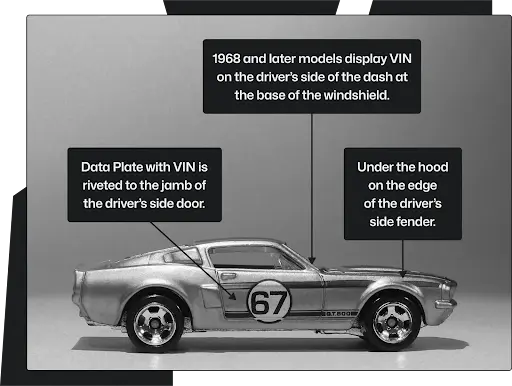
Finding your classic car’s VIN can be tricky since older cars placed them in different spots. Here are common places to find an old car VIN number.
- Dashboard by the Windshield: Look at the bottom corner of the driver’s side windshield where a small metal plate might be attached.
- Driver’s Side Door Jamb: Check the area where the door latches when closed for a metal tag with numbers and letters.
- Engine Block: Check if the VIN is stamped directly onto the engine block, usually on the front or side surface.
- Frame Rail: Look underneath the car along the frame rails near the front wheels for stamped numbers in the metal.
- Firewall: Check the metal wall separating the engine from the passenger compartment for a stamped or attached plate.
- Under the Hood: Open the hood and look on the inner fender wells or radiator support for identification tags.
- Trunk Area Some manufacturers placed identification plates inside the trunk, often near the spare tire or on the lid.
- Glove Box Check inside the glove compartment for a small metal tag that might contain the VIN or serial number.
- Vehicle Paperwork: Check titles, registrations, insurance documents, and old service records.
Do Window Stickers for Modern and Classic Cars Differ?
Modern and classic window stickers contain different information because rules changed over time. “Classic cars” here means vehicles built before VINs became standardized to 17 digits. Here’s what to expect from both stickers:
| Information | Classic Car Sticker | Modern Car Sticker |
|---|---|---|
| Vehicle specifications | ✔ | ✔ |
| Original MSRP | ✔ | ✔ |
| Mechanical features | ✔ | ✔ |
| Exterior color | ✔ | ✔ |
| Interior color | ✖ | ✔ |
| Safety and security | ✖ | ✔ |
| Options & packages | ✔ | ✔ |
| Fuel economy | ✖ | ✔ |
| Warranty information | ✖ | ✔ |
| NHTSA safety ratings | ✖ | ✔ |
| Price breakdown | ✖ | ✔ |
| Number produced | ✔ | ✖ |
| QR code | ✔ | ✔ |
| View sample | Sample classic sticker | Sample Modern sticker |
Get Classic Window Sticker by VIN for All Pre-1981 Car Models
Our tools allow the reproduction of window stickers for any classic vehicles manufactured since 1910. Select a brand below to get started:
Additional Tools for More Vehicle Information
Try out our other services and learn more about any vehicle history and details:
VIN Decoder
Decode any VIN for free to reveal basic details like the year, make, model, engine, and transmission.
VIN Check
Lookup records for accidents, thefts, mileage, titles, liens, and more from the car’s past life.
Window Sticker Lookup
Finds original factory stickers for any post-1981 vehicle with 17-digit VIN numbers.
License Plate Lookup
Enter the plate number to access the full vehicle history when you don’t have the VIN available.
Get a Reproduction Window Sticker for Any Classic Car
Don’t wait until it’s late before finding out a vintage car’s factory build details. Order your original reproduction window sticker to confirm options, features, MSRP, and more.
Frequently Asked Questions About Classic Window Stickers
Are classic window stickers legal?
Yes, reproduction window stickers are completely legal as long as they’re marked as reproductions and not fake originals. They’re meant for documentation, car shows, and personal records, not to deceive anyone about your vehicle.
Can I get a window sticker without a VIN?
Yes, our tool offers the option to get classic car window stickers using the year, make, and model. However, you cannot get the official window sticker from the manufacturer or dealership without the VIN (Vehicle Identification Number).
Does a window sticker increase car value?
Yes, having original classic car documentation often increases value because it proves authenticity and originality. Buyers pay more for cars with accurate and complete information showing original paint, engine, and options rather than a car with missing or unknown details.
Are reproduction window stickers accepted at car shows?
Yes, reproduction window stickers work great for car shows and displaying your vehicle. They show factory options and original pricing beautifully. However, judges don’t use them to prove your car is completely original or unmodified.
What's the difference between a build sheet and a window sticker?
A build sheet is the factory’s assembly guide listing every part and code used during production.The window sticker is a label displaying the MSRP, options, features, fuel economy, and more, to help buyers make informed purchasing decisions.
Is a classic window sticker worth it?
Yes, a window sticker is worth every penny. It’s useful especially if you’re buying or restoring your car, entering shows, or selling it to serious collectors who value documentation. The small cost pays off when buyers see you have proof of originality, and it helps preserve automotive history.