
Decode any VIN in Seconds: Get Accurate Vehicle Information
Enter your VIN into our VIN decoder to verify the vehicle’s specs, like year, make, model, trim, and engine size and capacity, for free. Easily prevent fraud and make an informed buying decision.

What is a VIN Decoder?
A VIN decoder is a tool that reads the unique 17-character VIN assigned to every vehicle ever made. Each section of the VIN holds specific information about the car, like where it was built, the year it was made, and what it came with.
By decoding a VIN (Vehicle Identification Number), you can instantly pull up details like the make, model, engine type, trim level, and more. This gives you a much clearer picture of exactly what a vehicle is before you spend any money on it.
What Does Our Free VIN Decoder Tell You About a Vehicle?
When you use our free VIN lookup tool, you get important details that help you understand exactly what you’re looking at. All of the information loads in seconds, completely free. No credit card required, no email signup, just straight answers. Here’s what you’ll get:
Year, Make, and Model
You’ll know if that “2020 Honda Accord” is really a 2020 or if the seller got the year wrong (or is lying). You’ll also confirm the exact model. Sometimes sellers confuse an LX with an EX, and those can have very different values.
Body Type
Is it a sedan, coupe, SUV, or truck? The body type affects everything from insurance costs to how much stuff you can haul around.
Engine Type and Capacity
You’ll find out if it has a 4-cylinder, V6, or V8 engine, plus the exact size (like 2.4L or 3.5L). Bigger engines usually mean more power but worse gas mileage. This matters a lot when you’re budgeting for fuel.
Transmission
Our VIN decoder shows whether it’s an automatic or manual transmission, and how many gears it has. Some people love driving a stick shift, while others want the ease of an automatic. Now you’ll know for sure.
Trim Level
The trim tells you which version of the model you’re looking at. An LX trim usually has basic features, while an EX or Touring trim comes loaded with extras like leather seats, sunroof, and better sound systems.
Fuel Type
Most vehicles run on regular gasoline, but some need premium fuel, diesel, or even electricity. If you’re looking at a car that requires premium gas, you’ll pay about 50 cents more per gallon every time you fill up. That adds up fast!
Number of Doors
This confirms whether it’s a 2-door or 4-door vehicle. Might seem obvious, but it matters for insurance rates and how easy it is to get kids or passengers in and out.
Estimated Market Value
We show you what the vehicle is worth in four different conditions: excellent, good, fair, and poor. This gives you a reality check on whether the seller’s asking price makes sense.
Base MSRP
This is what the vehicle cost brand new when it first hit the showroom floor. Knowing the original price helps you understand how much value the car has lost over time.
VIN Number: Meaning and Importance
VIN stands for Vehicle Identification Number, and it’s a special 17-character code that uniquely identifies every vehicle. Every car, truck, and SUV built after 1981 has this unique code stamped on it. When you’re buying a used car, the VIN tells you if the seller is being honest about what they’re selling.
Why VINs Matter When Buying Used Cars
The VIN Never Lies
Imagine someone sells you a “2020 Honda Accord” but it’s actually a 2018 model. That’s a big difference in value! The VIN never lies. It tells you the real year, the actual model, and exactly what’s under the hood.
The VIN Remains with the Car
Sellers can change listings, repaint cars, and swap badges. But they can’t change the VIN without breaking the law. Smart buyers always use a VIN decoder to verify a vehicle’s details before handing over the cash.
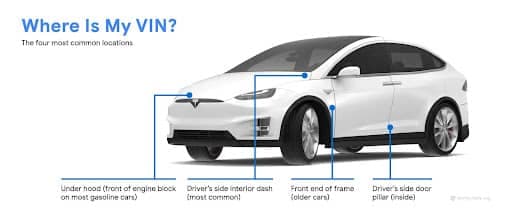
Where to Find the VIN Number?
On the Dashboard
Stand outside at the driver’s side. Look through the windshield at the bottom corner of the dashboard. You’ll see a small metal plate with the VIN stamped on it.
On the Driver's Door Jamb
Open the driver’s door and look at the frame where the door latches. There’s a sticker that shows the VIN, along with tire pressure information and the month the car was built.
Under the Hood
Pop the hood and look at the front of the engine. Some cars have the VIN stamped on the engine block. Others have it on the firewall (the metal wall between the engine and the inside of the vehicle.
On Your Vehicle Documents
Your VIN appears on important paperwork:
- Title (the most important document)
- Registration card
- Insurance card
- Owner’s manual
- Service records
How to Read a VIN Number: The Complete Breakdown
Every VIN is like a secret code. Once you know how to read it, you can access important details about any vehicle. Let’s break down what each number and letter means.
Let’s use a sample VIN to learn: 1G1ZD5ST8JF123456. We’ll go through this character by character so you understand exactly what you’re looking at.
World Manufacturer Identifier (WMI)
The first three characters tell you where the car was made and who built it. This section is called the World Manufacturer Identifier, but you can just think of it as the “origin code.”
1st Character: The Country Code
The first number or letter shows which country built the car.
- 1, 4, or 5 = United States
- 2 = Canada
- 3 = Mexico
- J = Japan
- K = South Korea
- S = England
- W = Germany
- V = France
- Z = Italy
In our example VIN (1G1ZD5ST8JF123456), the first character is “1”. That means this car was built in the United States.
2nd Character: The Manufacturer
The second character identifies the specific car company.
- G = General Motors
- F = Ford
- C = Chrysler
- H = Honda
- T = Toyota
- N = Nissan
- B = BMW
Our example has “G” in the second spot, so we know General Motors made this car.
3rd Character: Vehicle Type or Division
The third character gets more specific. It tells you which brand under that manufacturer or what type of vehicle it is.
For General Motors:
- 1 = Chevrolet
- 4 = Buick
- 6 = Cadillac
- 8 = Saturn (when they still made Saturns)
Our example VIN has “1” in the third position. So this is a Chevrolet made by General Motors in the United States. General Motors made this car.
Vehicle Descriptor Section (VDS)
These six characters describe the actual vehicle and the check digit. This is where you learn about the body style, engine, model, and safety features.
What These Characters Tell You
Every car company uses positions 4-8 differently, but they all include similar information:
- Body style: Is it a sedan, coupe, SUV, or truck?
- Engine type: What size engine does it have?
- Model: Is it a Civic, Camry, or F-150?
- Safety features: Does it have airbags? What safety equipment came standard?
- Restraint system: Information about seatbelts and safety systems.
In our example, characters 4-8 are “ZD5ST”. For a Chevrolet, this might tell us it’s a Camaro with a specific engine size and body style. But here’s the catch: each manufacturer has their own code book.
Character 9: The Check Digit
Position 9 is special. It’s called the “check digit,” and it’s like a security feature. Car manufacturers use a mathematical formula to calculate this number, plugging other VIN characters into the formula. This proves the VIN is real and hasn’t been tampered with. It’s usually a number or just “X.”
Vehicle Identifier Section (VIS)
These characters provide unique, specific information for each vehicle. It includes the model year, assembly plant, and a 6-digit production sequence number.
Character 10: The Model Year
Position 10 indicates the year the car was made and is represented by both letters and numbers. The year code chart table below will help you decode and find the model year of any vehicle.
Notice that I, O, Q, U, and Z never appear in the year code because they look too much like numbers. The letter I looks like 1. The letter O looks like 0. The letter Q looks like O. This prevents confusion and fraud.
In our sample VIN, position 10 is “J”, meaning this car was made in 2018 (it could also be 1988, but we’d look at other clues to know which one.)
Character 11: The Assembly Plant
Position 11 shows which factory built the car. Every manufacturer has factories in different places, and each factory gets its own code letter. In our example, position 11 is “F”. For Chevrolet, this might be their Fairfax, Kansas plant, plant or their Flint, Michigan plant. Our free VIN decoder knows which one.
Characters 12-17: The Serial Number
The last six characters are the vehicle’s serial number. It’s what makes your specific car different from every other car of the same make and model. Two cars might be identical twins: same year, same model, same color, same options. But their serial numbers will be different.
- A1980
- B1981
- C1982
- D1983
- E1984
- F1985
- G1986
- H1987
- J1988
- K1989
- L1990
- M1991
- N1992
- P1993
- R1994
- S1995
- T1996
- V1997
- W1998
- X1999
- Y2000
- 12001
- 22002
- 32003
- 42004
- 52005
- 62006
- 72007
- 82008
- 92009
- A2010
- B2011
- C2012
- D2013
- E2014
- F2015
- G2016
- H2017
- J2018
- K2019
- L2020
- M2021
- N2022
- P2023
- R2024
- S2025
- TNow2026
- V2027
- W2028
- X2029
The Importance of Using a VIN Decoder
Running a free VIN check helps everyone involved in buying and selling cars. Here’s how different people benefit:
Buyers
A quick VIN decoding can help used car buyers in the following ways:
Verify the Seller is Telling the Truth
Not all sellers lie, but some do. They might not even realize they’re giving you wrong information. The VIN number decoder catches these lies before you waste your time looking at the car.
Make Sure the Car Matches the Listing
When you arrive to see the car, decode the VIN right there. If it matches what they advertised, great! If not, you can point out the mistake and negotiate a fair price based on the actual vehicle.
Check if the Price is Fair
Our VIN decoding tool shows you the estimated market value. This gives you negotiating power. If they want $18,000 but similar cars sell for $15,000, you can make a lower offer. Why pay more than a car is worth?
Avoid Buying the Wrong Vehicle
Decode a VIN number before you test drive. Make sure it’s actually what you want. Imagine you want a V6 engine for towing your boat, but the car actually has a 4-cylinder. You wouldn’t find out until it’s too late. These mistakes cost you time and money.
Advanced VIN Decoder: Upgrade to Complete Vehicle History
Our free VIN decoder tells you what the car is. Our advanced VIN lookup tool tells you what the car has been through. Knowing the year, make, and model is helpful. But before you spend thousands of dollars on a used vehicle, you need to know its history.
When you upgrade to our full vehicle history report, you get every piece of record available about that specific vehicle. Here’s what we reveal:
Vehicle Specifications
Get every detail about the vehicle specifications, such as the year, make, model, engine, transmission, trim level, MSRP, and more.
Vehicle Usage
Find out how the vehicle has been used throughout its life. Was it a personal car, a rental, a commercial vehicle, or part of a fleet?
Ownership Records
See how many people have owned the vehicle and for how long. If a car has had six owners in three years, that’s a red flag. But one owner for eight years is usually a good sign.
Auction and Sales History with Photos
You’ll see if the vehicle was ever sold at auction. Many auction listings include photos, so you can actually see what the car looked like at different points in its history.
Title Brand Check
This reveals if the vehicle has any title brands. A “clean” title is what you want. But some vehicles have branded titles: salvage, flood damage, rebuilt, lemon, or odometer rollback.
Mileage History
Watch the odometer readings over time from inspections, registrations, and service records. The numbers should go up in a logical way. If not, this can signal an odometer rollback.
Accident Records
Find out if the vehicle has been in crashes and how serious they were. A minor fender bender isn’t a big deal if it was fixed properly, unlike a major accident with structural damage.
Theft Records
Check if the vehicle was ever reported stolen. Some stolen cars get recovered and end up back on the market, but they might have been damaged or stripped for parts.
Damage Verification
Beyond just accidents, this shows other types of damage: hail damage, fire damage, vandalism, or weather-related problems. A car that sat through a hurricane might have hidden water damage that shows up months later.
Lien and Loan Records
A lien means someone else (like a bank) has a legal claim to the vehicle because of an unpaid loan. If you buy a car that has an active lien on it, the bank can take the car from you.
Service and Repair History
See maintenance records when the vehicle was serviced at shops that report to databases. You’ll know if the owner kept up with oil changes, tire rotations, and other important upkeep.
Open Recall Records
Our report shows if there are any open recalls that haven’t been fixed yet. Some recalls are minor, but others affect serious safety systems like airbags or brakes.
How to Decode VIN Numbers Using Our Tool
Using our free VIN lookup tool is simple. Here are the simple steps to follow:
Enter the VIN
Scroll up to the VIN decoder input box. Type or paste your 17-character VIN into the box. Double-check that you entered it correctly.
Click "Search" to View Vehicle Specs
Hit the button and wait a few seconds. Our tool checks the VIN and reveals vehicle specs such as the year, make, model, engine, trim level, market value, and MSRP for free.
Upgrade for Full Vehicle History Report
If you’re buying a used car and want to know the complete history (accidents, owners, title problems, and more), make the necessary payment to access the vehicle history report.
Why Choose Our VIN Decoding Service
Our VIN decoder gives you fast, reliable vehicle information whether you’re checking modern cars, classic vehicles, or need complete history reports.
Instant & Accurate VIN Decoding
Get precise vehicle specifications in seconds from vehicle manufacturers (OEM) and government databases.
Covers All Vehicle Types
Our tool supports cars, trucks, motorcycles, RVs, and commercial vehicles from any manufacturer.
Classic Car VIN Decoding
Access specialized decoding for vintage and pre-1981 vehicles with 5-14 digit VIN numbers.
Easy Upgrade to Full Report
Easily upgrade from a basic specs check to get the complete vehicle history report.
Don't Stop Here - Get More With These Tools
Sometimes you don’t have the VIN handy, or you want even more information about a vehicle. We offer the following tools that help you research any cars easily:
License Plate Lookup
Don’t have the VIN handy? Search any vehicle specs and history with the US license plate number.
Window Sticker Lookup
Get window stickers for any vehicle type, showing all the options, features, original price, and colors.
Classic History Report
Find the history report for classic cars made before 1981. View the title, accident, mileage , and more.
Decode VIN By Makes
Frequently Asked Questions About VIN Decoder
What is a VIN decoder?
A VIN decoder is an online tool that translates a 17-character VIN (Vehicle Identification Number) into detailed information about a car, such as its manufacturer, year, engine type, and more. It breaks down this unique code to reveal specific car specs, features, and history, often used by buyers to verify vehicle details.
Is a VIN decoder really free?
Yes, our VIN decoder is 100% free! You can decode any VIN and see basic vehicle information without paying anything. Just enter the VIN, click the button, and view your results. If you want the complete history report with accidents, owners, title brands, and all the detailed records, that costs money.
How accurate is our VIN decoder?
We use available manufacturer, government, and vehicle-record sources to provide accurate VIN data where available. Results may vary depending on the records linked to the VIN.
Can I decode a VIN from any country?
Yes! You can use our VIN decoder from most countries outside North America to verify a vehicle’s specifications and history.
Will the VIN decoder show if a car was in an accident?
The free VIN decoder shows basic vehicle specs but not accident history. For accidents, you need our paid vehicle history report. The paid report shows:
- Every reported accident
- When it happened
- How severe it was
- What got damaged
- Insurance claim amounts
Can I Check Multiple VINs?
Absolutely! You can check as many VINs as you want. There’s no limit on how many times you can use our free VIN decoder.
Can a VIN tell me the model year?
Yes, the 10th character in the VIN indicates the model year. Our VIN number decoder can automatically translate this character into the actual year for you.
Does a VIN show accidents or ownership history?
Yes. To see accidents and ownership history, you need to run a full VIN number check to get the detailed vehicle history report.
Can classic or pre-1981 VINs be decoded?
Yes, you can decode a classic car VIN using a specialized VIN decoder like our tool. It helps verify the year, make, model, trim, engine, transmission, and more.
Does a VIN reveal engine size?
Yes, the VIN (Vehicle Identification Number)includes a code in the 8th position of the 17-digit VIN that identifies the engine type and size. A VIN decoder translates this into readable information like “3.5L V6.”
How can I get a window sticker using a VIN?
You can get a window sticker by VIN using our lookup tool. You only need to enter the VIN into our window sticker lookup tool to retrieve a copy of the factory window sticker showing original equipment, features, MSRP, pricing, colors, and more.