
Trailer VIN Lookup: See What the Records Show
Buying or selling a trailer? Run a trailer VIN lookup to check available accident, damage, title, theft, ownership, lien, and sales history before making a deal. Check now!
What Is a Trailer VIN?
A trailer VIN is a unique identification number assigned to a trailer.It identifies the trailer’s manufacturer, model, production year, and other specifications. The VIN is typically stamped or affixed to the trailer’s frame or identification plate. It’s used for registration, ownership records, insurance, recalls, and verifying the trailer’s history.
The exact meaning of each character varies by manufacturer because trailer makers use their own registered VIN decoding systems.
What Do You Get with a Trailer VIN Lookup?
A trailer VIN lookup gives you a clearer picture of the trailer's past, condition, ownership, and available records. Here’s what you can expect to see.
Trailer Specifications
See available details such as the trailer's make, model, year, body type, axle configuration, and other specifications. This helps you confirm that the trailer matches the seller's description.
Ownership History
Review available usage history and ownership records to see how the trailer has changed hands over time. This can help you better understand its background before buying or selling.
Branded Title Check
Check for title brands such as "salvage," "rebuilt," "flood," or other brands. A branded title can affect the trailer's value, insurability, and resale potential.
Theft Records
See available theft records associated with the trailer's VIN. This can help you identify if the trailer has been reported stolen.
Mileage History
Review available mileage records and recorded readings associated with the trailer. Comparing different readings can help identify potential inconsistencies.
Hidden Liens or Loans
Check available records for reported liens or loans associated with the trailer. Outstanding financial interests can create complications when transferring ownership.
Service and Maintenance History
Review available service and maintenance records to see what work has been reported over the trailer's lifetime. These records can provide useful insight into how the trailer has been maintained.
Accident Records
Check for reported accidents or collision events associated with the trailer's VIN. These records can help you identify incidents that may not be obvious from a visual inspection.
Damage Records
Find available damage records associated with the trailer. This can help you verify reported damage and compare the records with the trailer's current condition.
Auction History
See available auction records with images connected to the trailer. Previous auction listings can provide useful clues about its condition, damage, or selling history.
Sales History
Review available sales records to see previous transactions involving the trailer. This can help buyers understand its market history and give sellers useful background information.
Recall Information
Check available recall information associated with the trailer's VIN. This can help you identify reported safety issues that may require attention.
Benefits of a Trailer VIN Lookup
A trailer can be expensive equipment, and its appearance does not always tell you the full story. A trailer VIN number lookup gives you another way to verify important information before buying, selling, registering, or insuring one.
Buyers
Avoid Problem Trailers
Check available title, damage, theft, and other records before spending your money.
Know What You're Buying
Compare the trailer's reported details with the seller's description and paperwork.
Spot Hidden Damage
Find available accident and damage records that may not be obvious from a visual inspection.
Avoid Title Problems
Check for available salvage, flood, rebuilt, and other title brands before taking ownership.
Check for Theft Records
See if available records show the trailer has previously been reported stolen.
Where Is the VIN Number on a Trailer?
Wondering where the VIN number is on a trailer? Start with the front section of the trailer. Look for a VIN plate, sticker, or stamped number on the frame or tongue.
Common Places to Check
- Tongue or A-frame: Near the coupler or front frame.
- Frame: Look for a number stamped directly into the metal.
- Certification Label: Usually lists the VIN along with weight ratings and manufacturer details.
- Gooseneck or Fifth-Wheel: Check around the front neck or coupling area.
- Trailer Documents: Check the title, registration, or manufacturer's paperwork if you can't find it on the trailer.
How to Read a Trailer VIN
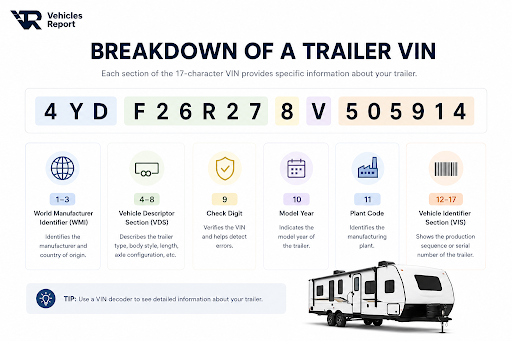
A trailer VIN is divided into sections that provide different types of information.
Manufacturer Identifier (Characters 1-3)
The first three characters form the World Manufacturer Identifier (WMI). They identify the manufacturer and, depending on the manufacturer and VIN structure, the make and type of vehicle.
Trailer Description (Characters 4-8)
Characters 4 through 8 describe attributes of the trailer. For trailers, manufacturers use these positions to identify characteristics such as trailer type, body type, length, and axle configuration.
Check Digit (Character 9)
The ninth character is the VIN's check digit. It is mathematically calculated from the other VIN characters and helps detect errors when the VIN is entered or transcribed.
Model Year (Character 10)
The 10th character represents the trailer's model year under the VIN system. The character corresponds to a specific year according to the applicable VIN year-code system.
Manufacturing Plant (Character 11)
The 11th character identifies the manufacturing plant. The meaning of the character is determined by the manufacturer's VIN-decoding information.
Production Sequence (Characters 12-17)
The remaining characters identify the trailer's production sequence. Smaller brands can use some of these positions as part of an expanded manufacturer identifier.
Important: Do not assume that every trailer uses the same meaning for characters 4 through 8 or other characters. Trailer manufacturers submit their own decoding information, so to be sure, you need to use a VIN decoder.
Use Case: Seller’s Deal Was Too Good to be True
Chris found a 2006 Cabin Trailer 5th Wheel listed for $9,200, well under its $38,244 retail value. The seller called it "well maintained."
Asking Price
$9,200
Retail Value
$38,244
What the Report Disclosed
- Branded title with flood damage and salvage/rebuilt status
- 3 reported accidents between 2014 and 2018
- Active lien filed in Florida, never released
- Auction listed it as salvage, extent of damage unknown
Result: Chris had to walk away from the offer. The steep discount wasn't a bargain, it was a warning sign. A trailer with flood damage and a salvage title carries real risks: hidden structural or electrical issues, difficulty insuring or registering it, and a lien that could leave Chris legally exposed even after paying for it.
Free Trailer VIN Lookup vs. Full History Report
If your main question is simply "what kind of trailer is this," the free check is the right place to start. If you're buying, financing, or need to confirm the trailer's legal status before towing, the full report goes much deeper.
Free VIN Check | Full Vehicle History Report | |
|---|---|---|
Trailer type | ✅ | ✅ |
Year, make, and model | ✅ | ✅ |
Basic body and frame details | ✅ | ✅ |
Title status (clean, salvage, rebuilt) | — | ✅ |
GVWR and weight ratings | — | ✅ |
Axle count and configuration | — | ✅ |
Full ownership and registration history | — | ✅ |
Reported liens | — | ✅ |
Reported accidents or damage | — | ✅ |
Prior sale and listing records | — | ✅ |
What Do Your Trailer Specs Mean?
A VIN tells you more than an identification number. Understanding the trailer's basic specifications can help you determine if it is suitable for your vehicle, cargo, and intended use.
GVWR: Gross Vehicle Weight Rating
The maximum weight the trailer is designed to carry when fully loaded. Check it against your tow vehicle and the trailer's intended use.
Axles
Trailers may have single, tandem, or triple axles. The axle setup affects how the trailer carries weight and handles on the road.
Hitch Type
Common setups include bumper pull, gooseneck, and fifth wheel. The hitch type determines how the trailer connects to your tow vehicle.
Weight & Capacity
Empty weight is what the trailer weighs without cargo, while cargo capacity is how much additional weight it can carry. Together, they help you understand the trailer's usable capacity.
When Should You Check a Trailer's VIN?
A trailer VIN number check can be useful in several situations.
1. Before Buying a Used Trailer
Check the VIN before handing over money. Compare the available information with the trailer and seller's description.
2. Before Selling a Trailer
Verify the trailer's details so your listing contains accurate information and you can answer potential buyer questions.
3. Before Registering a Trailer
Have the correct information ready when handling registration or title paperwork. Requirements vary by state, so check with your state DMV for the documents you need.
4. When Insuring a Trailer
Insurance companies may need identifying information about the trailer. Having the correct VIN and manufacturer details can make the process easier.
What a Trailer VIN Lookup Cannot Confirm
A trailer VIN lookup shows valuable history and factory information, but it cannot tell you everything about the trailer's current condition. Here’s what you cannot see with a Trailer VIN lookup:
What It Cannot Confirm | Why It Matters |
|---|---|
Current Condition | Cannot show every sign of wear, rust, or damage. |
Unreported Damage | Damage that was never reported may be missing. |
Unreported Accidents | Privately handled accidents may leave no record. |
Current Modifications | Aftermarket changes may not be included. |
Structural Integrity | History records do not confirm whether the frame, welds, or suspension are actually sound. |
Trailer Types You Can Research by VIN
Different trailers serve different purposes, but a VIN can help identify the equipment and available factory information. Some common trailer types you can check are:
| Utility Trailers | Cargo Trailers | Travel and RV Trailers |
| Boat Trailers | Horse and Livestock Trailers | Flatbed Trailers |
Explore More Vehicle Tools
Your trailer VIN is only one way to research a vehicle. Explore our other tools for additional information.
Window Sticker Lookup
See your vehicle's original factory details, including pricing, equipment, colors, options, and more.
Recall Check
Check for available recalls linked to your vehicle and stay aware of potential safety issues.
License Plate Lookup
Don't have the VIN? Use the license plate to find available vehicle information instead.
Classic VIN Lookup
Look up older and classic vehicles using their VIN and explore available vehicle details.
Why Choose Vehicles Report?
Get more than a basic VIN decode. Vehicles Report brings available history and vehicle data together to help you research a trailer before buying, selling, or adding it to your inventory.
Detailed History Reports
Accident, title, mileage, ownership, theft, and more.
Auction History & Photos
See auction records and photos when available.
Free VIN Decoder
Preview basic vehicle details before purchasing.
Multiple Data Sources
Access records compiled from multiple trusted sources.
Affordable Reports
Save up to 67% compared with Carfax.
Built for Businesses
Use bulk plans for higher-volume VIN checks.
Know What You're Buying Before You Tow It Away
A trailer may look exactly like the seller describes it, but the VIN gives you another way to verify the details. Check the VIN, compare the results with the trailer and its paperwork, and make a more informed decision before you buy, sell, register, or insure it.
FAQs About Trailer VIN Checks
What is a trailer VIN?
A trailer VIN is a unique identification number assigned to a trailer. Modern U.S. trailers generally use a 17-character VIN that identifies the manufacturer and can encode information about the trailer's characteristics, model year, plant, and production sequence.
Where is the VIN number on a trailer?
To find the VIN number on a trailer, start with the certification label and the front portion of the trailer frame. Common locations include the tongue, A-frame, frame rail, or another forward section of the trailer.
How do I decode a trailer VIN?
To decode trailer VIN information, enter the complete VIN into a trailer VIN decoder. The available result can include the manufacturer, model year, trailer attributes, and other specifications depending on the manufacturer and available data.
Can I get a trailer VIN lookup for free?
Yes, we have a free trailer VIN lookup option that provides basic VIN decoding and available vehicle information. If you need more than basic specifications, you will have to make a payment for a vehicle history report.
Can I use a VIN decoder for an RV or camper trailer?
Yes. A camper trailer VIN lookup or RV trailer lookup can help identify available information for a recreational trailer. The amount of information available depends on the manufacturer, model year, and database coverage.
Can I check a semi-trailer or tractor-trailer by VIN?
Yes. A semi-trailer VIN lookup or tractor-trailer VIN lookup can be used to research the trailer portion of a commercial towing setup. The trailer has its own VIN, separate from the VIN of the tractor or truck pulling it.
What if my trailer has no 17-digit VIN?
Some older trailers may use identification or serial-number formats that differ from the modern 17-character VIN system. If you find a VIN number within 5 to 14 digits belonging to a classic car made before 1981, you can decode it and view past records with our classic car VIN lookup tool.